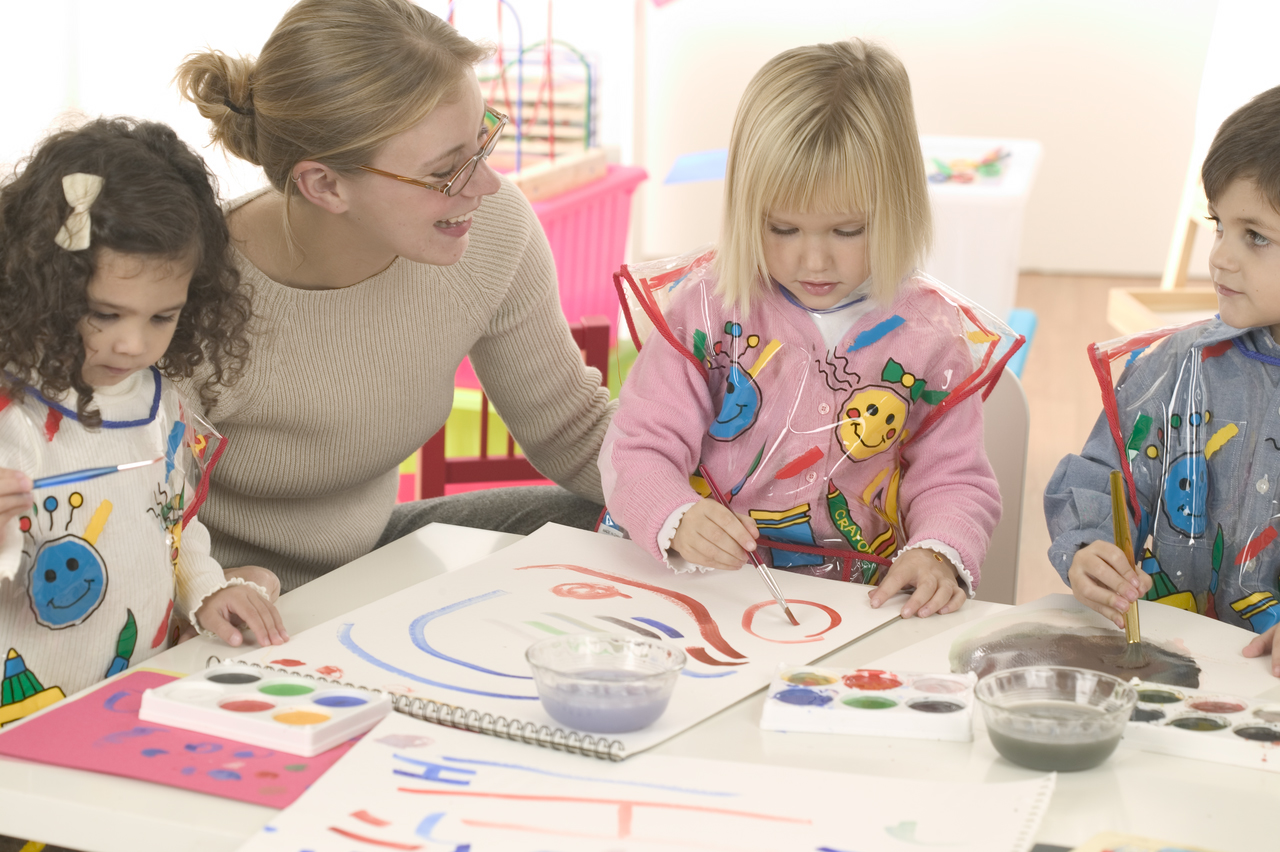
Painting Resources
The first thing you need to do before you begin teaching painting is to understand a few basics of the vocabulary of art. The elements of composition listed below are tools that artist need to complete a work of art. You can create a painting by focusing on one of the elements, but all works of art have all 5 ingredients. The more you know about this tools the better you can share them with your group. Click on the link to find words that describe these elements.
Lines have a descriptive but also emotive quality associated with them. Go to the link above and paint the line that is described. What emotional quality does it evoke?
Texture is that which you can see and feel. Visit the texture line above. Create a sample quilt of textures around you using a variety of media. Do some rubbings and create a work of art from them.
The feel of space in a composition can be created in several ways-overlapping, relative size, placing objects high or low in the compositional plane, through color choices and through geometric perspective. Create a painting showing 3 different ways of vantage points. Do this by creating 3 different horizon lines. Keep the painting simple.
After reading the Color website above, mix your own colors using tempera or acrylic paint. Create a color wheel.
There are basic shapes that you can use to help you in your painting. Create an animal using just a square, circle and triangle shapes.
Themes in Art
There are all kinds of themes that are of interest to children and young adults. Here are just a few:
Portraits, Self-Portraits, Animals, the Environment, Vacation, Travel, Adventure, Dreams, Fashion, Music, Cartoons, Pioneers, Cultures around the World, Abstraction, Nature, Famous Artists, Favorite Books, Poems, Ocean Environments, Fish, Endangered Wildlife, Space Travel, Celebrities, Neighborhood, Sports, Music, etc.
Use a Variety of Mediums
Along with paints-acrylics,tempera,watercolor, etc. experiment with mixed media-paint and yarn, collage, found objects. Also use colored markers, colored pencils, pastels, and charcoal.
Encourage, Encourage, Encourage
One of the most important qualities that you can share with your group is creative encouragement. Don't place limits on your group. Let them experiment and create without negative feedback. There is no wrong way in art.
Painting is fun for children and adults. You can encourage and facilitate painting if you know a few things about art and teaching children.

Coloring Pages can be used as inspiration for paintings, mosaics and other art projects. Here is a sampling of monthly coloring pages from Apples 4 the Teacher Website.
http://www.apples4theteacher.com/coloring-pages/index.html
Kinderart has a number of excellent sources of painting projects for preschool and young children. You will find them at
Kinderart Painting Links
http://www.kinderart.com/painting/
 Return
to Lesson
Return
to Lesson